
Stepping off a long-haul flight feeling utterly exhausted, disoriented, and wide awake at three in the morning is a traveller’s rite of passage. Yet while we often blame the uncomfortable seats and the dry cabin air, the real culprit is invisible. Crossing multiple time zones wreaks havoc on your internal biology, leaving you battling that dreaded condition: jet lag. Understanding how to reset your circadian rhythm is the difference between spending the first three days of your holiday napping in a dark hotel room, or hitting the ground running, energised and ready to explore. By taking control of your internal body clock before, during, and after you fly, you can significantly reduce your recovery time and start enjoying your destination much sooner.
What Happens to Your Body Clock When You Fly?
To understand jet lag, you first need to understand the circadian rhythm. This is your body’s internal 24-hour clock, located in the suprachiasmatic nucleus (SCN) of the brain. It dictates when you feel hungry, when you produce hormones like cortisol and melatonin, and crucially, when you fall asleep and wake up.
Your SCN relies on external cues, known as zeitgebers (German for “time givers”), to keep perfect time. The most powerful zeitgeber is natural light. When you fly across several time zones, your internal clock remains stubbornly synced to your point of origin. If you land in Bangkok at 8:00 AM, the bright morning sunlight signals to your brain that it is time to wake up, but your body clock still thinks it is 2:00 AM back in London. This mismatch between external cues and internal biology is what causes the physical and mental exhaustion we know as jet lag. Research published in the Journal of Clinical Medicine indicates that this desynchronisation can affect everything from cognitive performance and mood to digestive health.
East vs. West: Why Direction Matters
Not all long-haul flights are created equal. If you have ever felt significantly worse after flying one way compared to the other, you are not imagining it. The direction of travel has a profound impact on your body’s ability to adjust.
Flying West: Lengthening Your Day
When you fly west (for example, from London to New York), you effectively extend your day. Your body generally finds it much easier to delay sleep than to initiate it early. Because the natural human circadian rhythm actually runs slightly longer than 24 hours (closer to 24.2 hours), adjusting to a longer day feels more natural. Most travellers can adapt to westward travel relatively quickly.
Flying East: Shortening Your Day
Flying east (from New York to Paris, or the UK to Asia) requires you to shorten your day and go to bed earlier than your body wants to. This is significantly harder for the brain to manage. A widely cited rule of thumb, supported by the CDC’s Yellow Book, is that it takes roughly one day of recovery for every time zone crossed when flying east, whereas it takes about one day for every one and a half time zones when flying west.
The Pre-Flight Strategy: Shift Your Clock Early
The most effective way to combat jet lag is to begin shifting your circadian rhythm before you even leave for the airport. You do not need to fully adopt the destination’s time zone while you are still at home, but making small adjustments can lessen the shock to your system.
About three to four days before your departure, try the following:
- Flying East: Wake up 30 to 60 minutes earlier each day and go to bed 30 to 60 minutes earlier. Expose yourself to bright light as soon as you wake up, and avoid bright lights in the evening.
- Flying West: Stay up 30 to 60 minutes later each night and sleep in a little later. Expose yourself to bright light in the early evening to trick your brain into delaying sleep.
- Optimise Sleep Hygiene: Ensure you are well-rested before you travel. Starting a long-haul trip with a sleep debt makes jet lag symptoms significantly worse.
In-Flight Tactics for a 12-Hour Journey
Surviving a 12-hour flight in economy requires a tactical approach. The environment inside a commercial aircraft—low humidity, cabin pressure equivalent to an altitude of 8,000 feet, and constant noise—actively works against quality sleep. Here is how to optimise your time in the air.
Set Your Watch Immediately
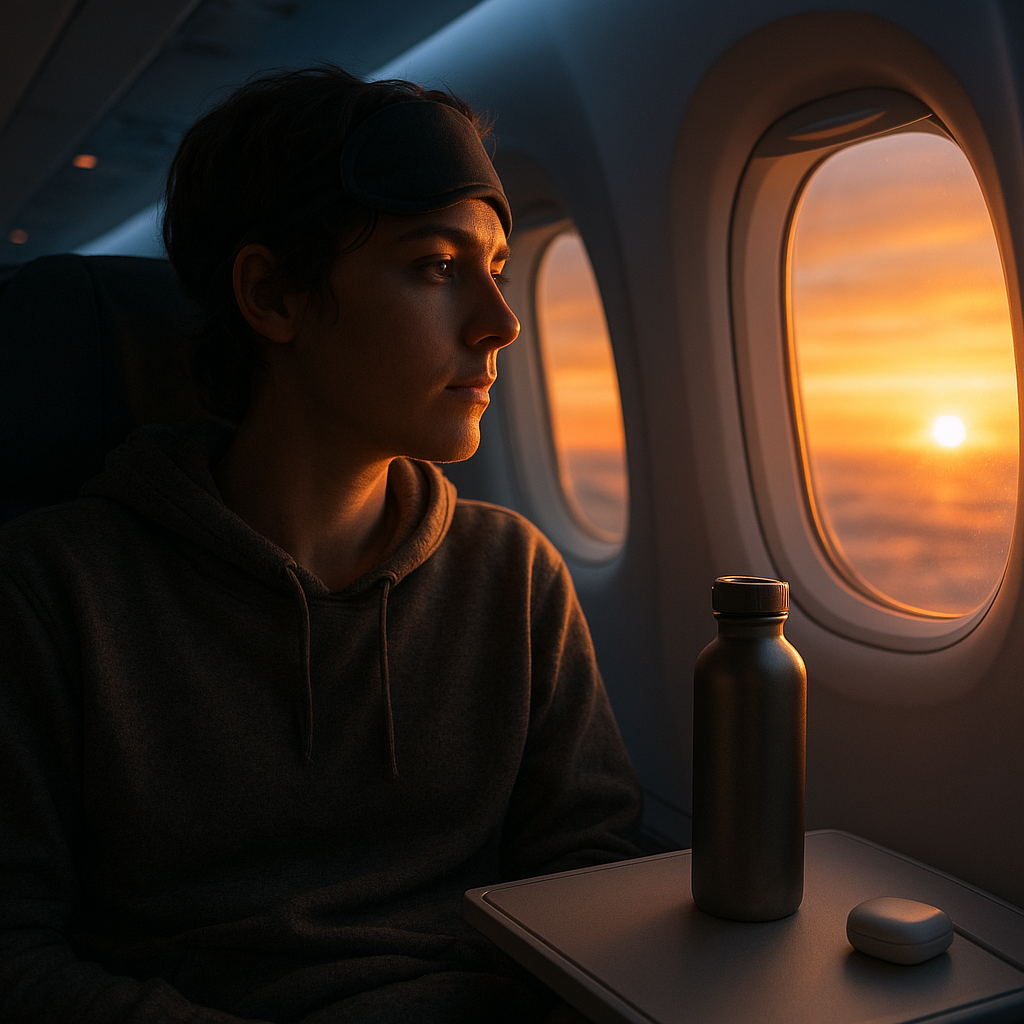
As soon as you sit down in your seat, set your watch or phone to the destination’s time. This is a crucial psychological trick. From this moment forward, try to live on your new time. If it is midnight at your destination, your goal is to sleep, even if your body feels wide awake.
Manage Your Sleep Environment
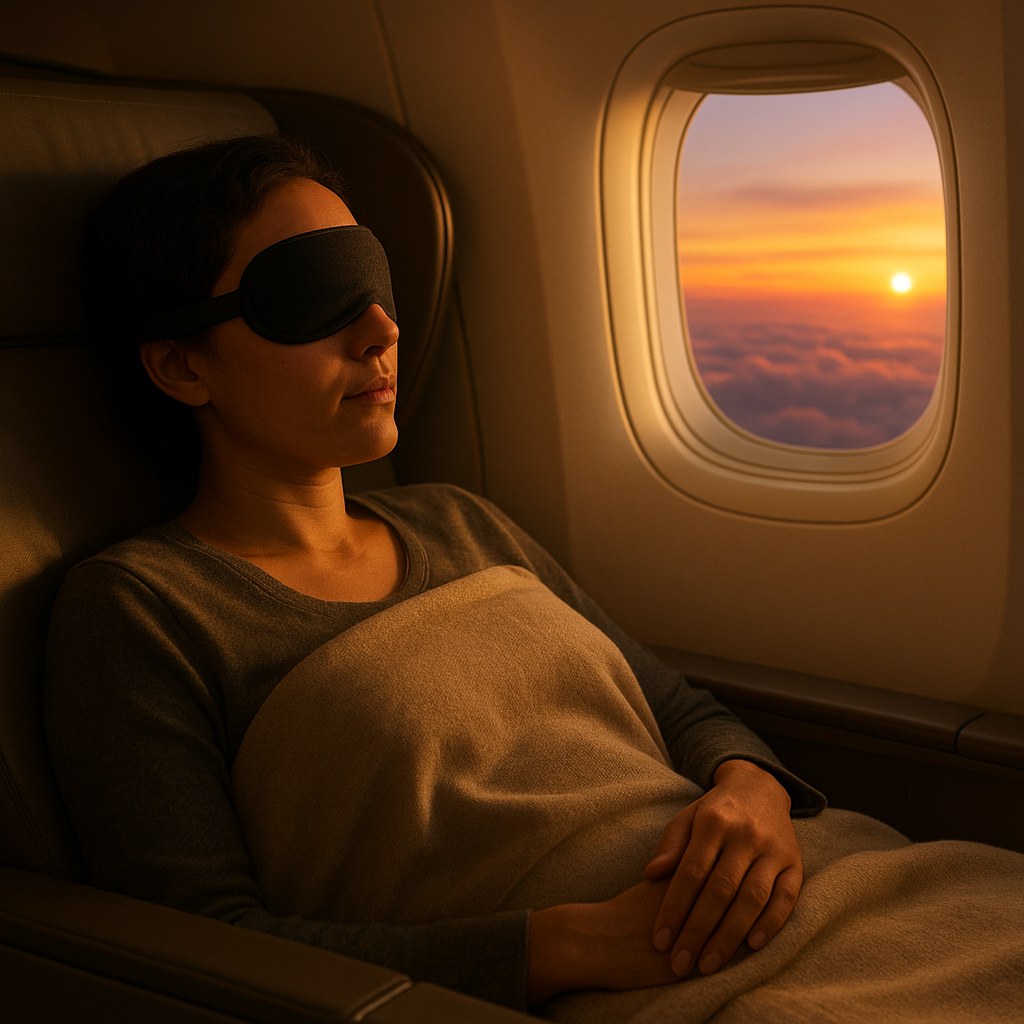
To get rest in a cramped economy seat, you need to block out the cabin environment. A high-quality eye mask is essential, as is a pair of noise-cancelling headphones or foam earplugs to drown out engine hum and crying infants. A supportive travel pillow can prevent your head from dropping, reducing micro-awakenings. Dress in loose, comfortable layers, as cabin temperatures fluctuate wildly.
What Can I Take to Help Me Sleep on a Long Haul Flight?
If you struggle to sleep on planes, certain over-the-counter aids can help, but they should be used cautiously. Diphenhydramine (found in many ‘nighttime’ cold medicines) or mild antihistamines can induce drowsiness, but they often leave you feeling groggy upon waking. Melatonin is a popular alternative (more on that below). Crucially, avoid alcohol. While a glass of wine might help you fall asleep faster, alcohol severely disrupts REM sleep and exacerbates dehydration, leading to worse jet lag overall. The same applies to heavy, rich meals; opt for light snacks if you want to sleep well.
Harnessing the Power of Melatonin
Melatonin is a hormone naturally produced by the pineal gland in response to darkness. It signals to your body that it is time to sleep. When your circadian rhythm is misaligned, your brain might be pumping out melatonin at 2:00 PM local time, leaving you groggy, or failing to produce it at midnight, leaving you staring at the ceiling.
Should I Take Melatonin Before a Flight?
Taking melatonin at the right time can act as a powerful chronobiotic—meaning it can actively shift your internal clock. However, timing is everything. Taking it at the wrong time can actually make jet lag worse by shifting your clock in the opposite direction.
As a general guideline, according to sleep specialists at Johns Hopkins Medicine and other sleep foundations:
- Flying East: You need to advance your body clock. Take melatonin at bedtime (local destination time) starting on the first night of your arrival. Some experts suggest taking a small dose (0.5mg to 3mg) a few days before travel in the late afternoon (home time) to start advancing your clock.
- Flying West: You need to delay your body clock. Melatonin is generally less critical here, as staying awake is easier. If you do wake up too early at your destination, a small dose in the early morning can help you sleep a little longer, though bright light avoidance is usually more effective.
Always consult with a healthcare professional before starting any new supplement, especially if you are pregnant, have underlying health conditions, or take other medications.
Landing: How to Beat the 3 AM Wake-Up
You have arrived at your destination. You navigated the flight, survived the food, and checked into your accommodation. Now, the real work of resetting your circadian rhythm begins. The biggest mistake travellers make is giving in to the temptation to sleep immediately upon arrival, or taking long afternoon naps.
The Golden Rule of Light Exposure
Light is your most potent weapon. To shift your clock to the local time, you must seek or avoid light at specific times. If you need to wake up earlier (flying east), get outside into the bright morning light as soon as you wake up, and avoid bright light in the late evening. If you need to stay awake longer (flying west), get plenty of afternoon and early evening light, and dim the lights a couple of hours before your target bedtime.
Dealing with Jet Lag Waking Up at 3 AM
Waking up at 3:00 AM feeling wide awake and starving is perhaps the most frustrating symptom of jet lag. This happens because your body clock thinks it is morning, spiking cortisol (the stress hormone) and hunger hormones. If this happens, do not lie in bed tossing and turning, as your brain will begin to associate the bed with wakefulness. Keep the lights very low, read a boring book, and have a small, non-sugary snack if you are hungry. Do not check your phone, as the blue light will actively destroy any melatonin production and make it harder to fall back asleep. Building your tolerance for unexpected delays and sleep disruption can help you stay calm and ready when travel plans don’t go perfectly.
Understanding Jet Lag Recovery Timelines
It is important to manage your expectations. Even with perfect light exposure and melatonin timing, your body cannot instantly teleport its biological clock.
What is the Hardest Day of Jet Lag?
For most travellers, the hardest day of jet lag is the second day (and particularly the second night). On the first day, you are often running on adrenaline and excitement, which masks the fatigue. By the second day, the sleep debt catches up with you, and your body clock is still deeply confused. Expect a significant dip in energy and mood around days two and three. Plan your itinerary accordingly—schedule relaxing activities for the first few days rather than high-stakes business meetings or gruelling mountain treks.
Can You Get Jet Lag from a 2 Hour Flight?
Generally speaking, no. The human body can easily absorb a one to two-hour time shift without experiencing clinical jet lag. Most people will simply feel a bit of “travel fatigue” from the stress of the airport and sitting for a long period. True jet lag typically requires crossing at least three time zones rapidly.
Using a Jet Lag Recovery Calculator
If you want to take a highly scientific approach to your travel sleep, consider using a jet lag recovery calculator. These online tools ask for your departure city, destination, and flight times, and generate a custom schedule telling you exactly when to seek light, when to avoid light, when to drink caffeine, and when to take melatonin. They remove the guesswork from the equation.
Jet Lag After Returning Home
Many people forget that they will have to go through the adjustment process all over again when they return home. Re-entry jet lag can sometimes be worse, especially if you have to return to work immediately. Try to schedule your return flight to arrive home in the evening if possible, so you can have a light meal and go straight to bed at a reasonable local hour. Give yourself at least one full day at home to rest before returning to the office, and rely heavily on morning sunlight to anchor your body clock back to home time.
Conclusion
While jet lag is an inevitable part of global travel, it does not have to ruin your trip. By understanding the science of your circadian rhythm, you can stop fighting against your biology and start working with it. The key to resetting your body clock lies in proactive preparation: shifting your sleep schedule in the days before you fly, managing your exposure to light and darkness, staying hydrated in the air, and using tools like melatonin strategically and safely. Accept that the first few days will require patience, avoid over-scheduling your itinerary, and give your body the time it needs to synchronise with its new surroundings. With these strategies in your travel toolkit, you can conquer even the longest long-haul flights and make the most of every moment at your destination.